Research Interests of the group can be mainly summarized in terms of the following research directions:
Black Hole Interiors and Gravitational Radiation
Principal Investigator: Jörg Frauendiener.
Black hole interiors offer one of the most exotic and least understood environments in physics, not only because of our inability to explore them observationally, but also because of the complicated analysis of Einstein’s equations needed for such a task. This problem is further complicated by the possible presence of spacetime singularities and Cauchy horizons beyond the event horizon, the thing that can be related to the failure of determinism inside of black holes. On the other hand, what is known about these singularities and Cauchy horizons is almost always informed by exact solutions to the equations, ones that are derived based on symmetry assumptions. Hence, the question of whether these solutions are stable to less symmetric perturbations, and hence robust as models of astrophysical black holes remains relevant.
Another related issue is trying to have a complete understanding of the propagation of gravitational radiation and its possible interaction with other compact objects. This requires analyzing Einstein’s equations under a bigger symmetry group, the so-called conformal group, which is relevant for studying the asymptotic behaviour of massless radiation.
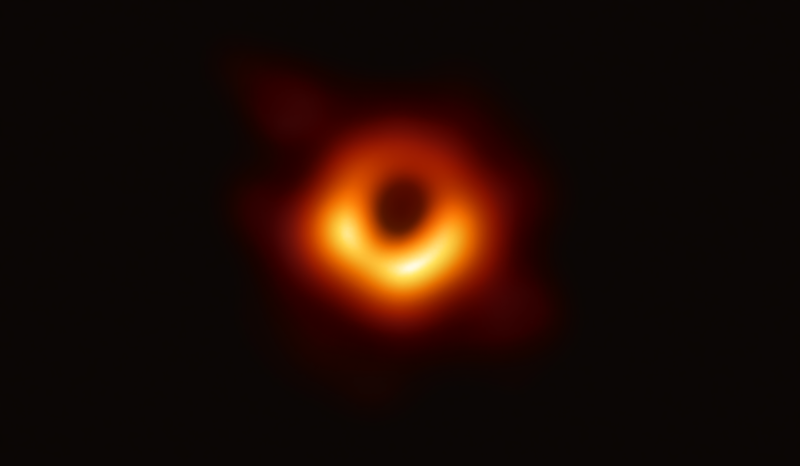
The supermassive black hole at the centre of the M87 galaxy (Credits: Event Horizon Telescope).
In this respect, we develop numerical codes, based on integrating the conformal Einstein’s equations, to address many of the above mentioned issues.
Big Bang Models of Cosmology
Principal Investigator: Florian Beyer.
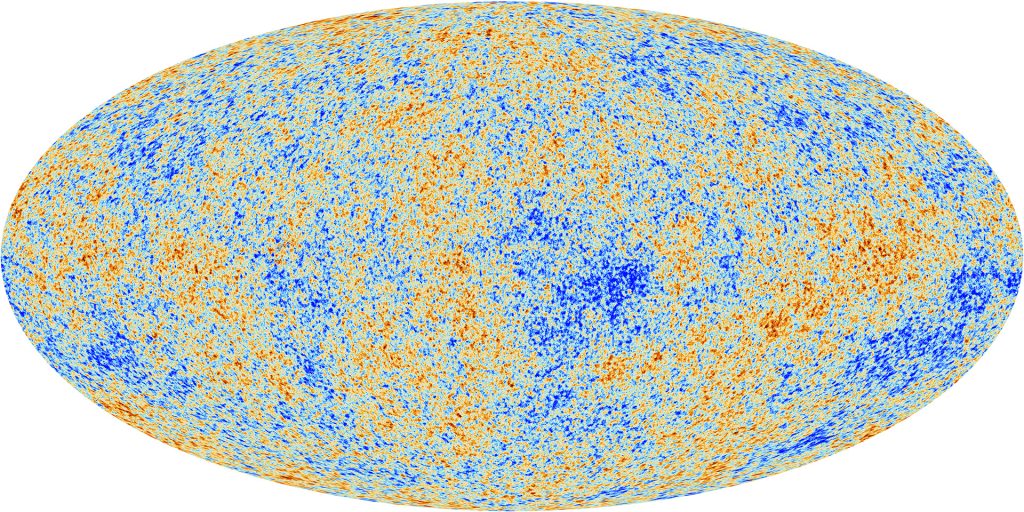
The Cosmic Microwave Background (CMB) Radiation, which represents a glimpse of the Universe 380,000 years from the big bang (Credits: ESA-Planck).
Understanding the large-scale structure and evolution of our universe has been one of the triumphs of modern cosmology during the past 50 years. However, some aspects of this understanding remain unresolved, particularly in relation to the cosmic singularity and the dynamics associated with approaching the distant past of the universe. Part of this issue is related to the fact that the standard models of cosmology are often based on imposing symmetry assumptions that make little contact with the complexity of the real universe. As a result, an important question that arises is regarding the robustness of these models, namely whether the same models would still hold if these assumptions were relaxed. On the other hand, the celebrated “Singularity Theorems” of Penrose and Hawking show that a singularity, in terms of geodesic incompleteness, is to be expected in the past of our universe under generic assumptions. However, the structure of the proof of the theorems does not allow any detailed information about the asymptotics in approaching such a singularity.
In this respect, we study the asymptotics of Einstein’s equations, based on techniques from the theory of Fuchsian PDEs, to address many of the above mentioned and other related issues.
Exact Solutions and Numerical Methods
Principal Investigator: Jörg Hennig.
Einstein’s field equations give rise to a rich variety of exact solutions with highly non-trivial global and causal structures, for example black holes or cosmological models with Cauchy horizons. An important question then is to understand the mathematical properties of such solutions, their physical relevance, and the extent to which their characteristic features remain robust beyond highly symmetric settings. This bears on many open questions in general relativity, including universal black hole properties, equilibrium configurations of multiple black holes and the behaviour of fields near spacelike and null infinity.
In this respect, we combine analytical and numerical methods, whether techniques from soliton theory or highly accurate pseudospectral methods for time-dependent PDEs, to address many of the above mentioned and other related issues.
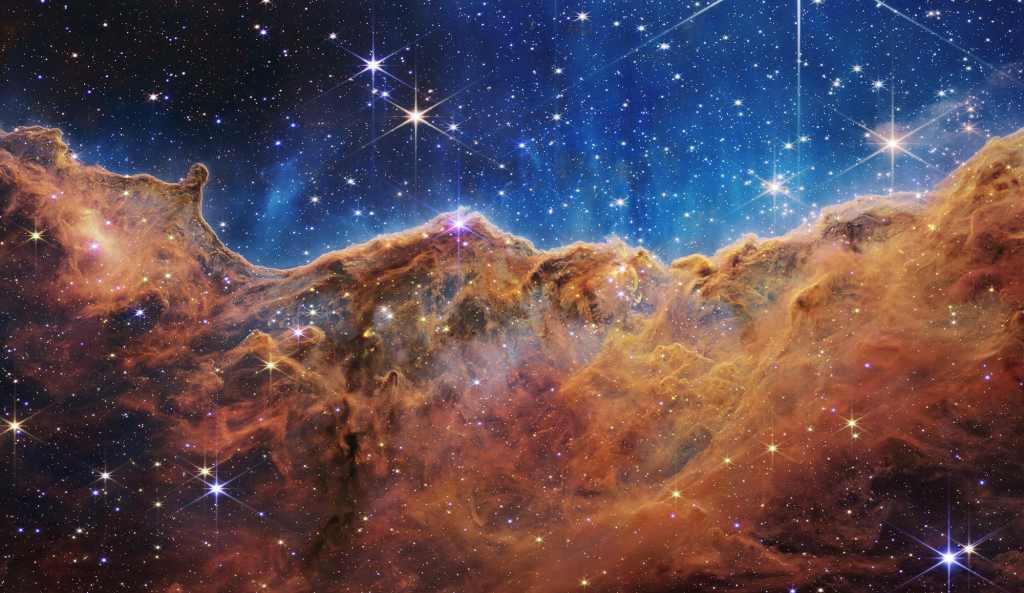
The “Cosmic Cliffs”, which represent the edge of a star-forming, and hence a black hole-forming, region inside the Carina Nebula (Credits: NASA/ESA-JWST).