Jörg Hennig: Home, Research, Publications, CV
My research focuses on General Relativity — Einstein’s geometric theory of gravitation. In particular, I study axisymmetric and stationary spacetimes, cosmological models, and the application of pseudo-spectral methods to numerical solutions of hyperbolic partial differential equations.
Axi-symmetric and Stationary Spacetimes
Axisymmetric and stationary spacetimes provide a mathematical framework for describing equilibrium configurations in General Relativity. For instance, they can represent systems consisting of a central black hole surrounded by matter. It can be shown that several properties of the Kerr solution — the exact solution describing a single rotating black hole in vacuum — remain valid even when the black hole is perturbed by surrounding matter. In particular, we have proved a universal inequality for such black holes, which establishes an upper bound on the rotation rate. Moreover, using methods from soliton theory, one can show that the central black hole always possesses an inner Cauchy horizon.
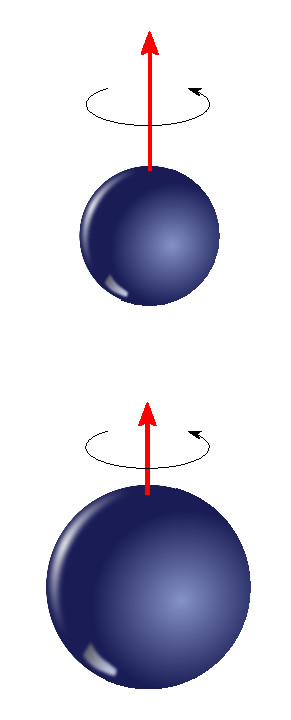
I also study axisymmetric configurations of two black holes. In this case, it has been shown that such configurations cannot be in equilibrium, thereby providing a negative answer to the long-standing balance problem for two black holes. For configurations involving charged black holes or more than two black holes, the problem remains open, although some progress has been made regarding the structure of possible solutions.
Two aligned black holes cannot be in equilibrium, since spin–spin repulsion is not strong enough to balance gravitational attraction.
Topology and Causal Structure of Cosmological Models
Illustration of the causal structure of an exact Gowdy-symmetric cosmological model. Further details are available here.
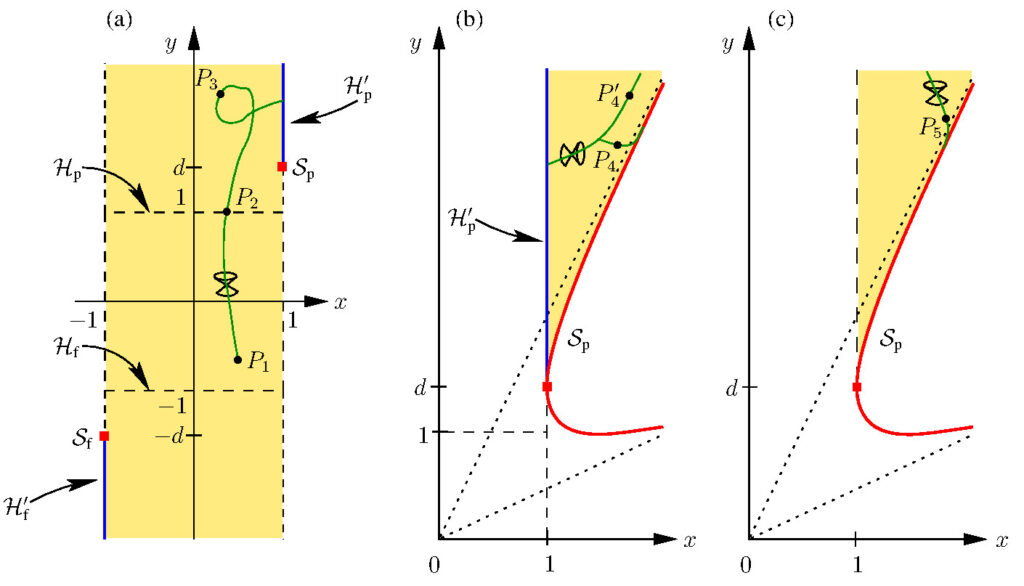
Similar mathematical techniques from soliton theory can also be applied to the investigation of Gowdy-symmetric spacetimes, which are cosmological models with two symmetries. I am particularly interested in the local and global existence of solutions with different spatial topologies, the study of their properties, and the derivation of exact solutions.
Remarkably, one can construct cosmological models that contain closed causal curves, i.e. solutions in which genuine time travel would be possible — in clear violation of causality.
Numerical Relativity
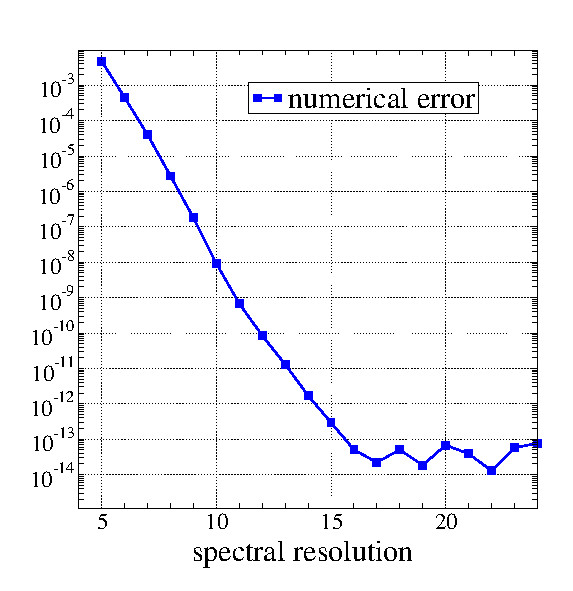
I am also interested in numerical relativity, where the differential equations arising from Einstein’s field equations are solved using numerical methods. This is important for the simulation of dynamical processes in general relativity. As a promising approach, we have developed a fully pseudo-spectral numerical scheme in which spectral expansions in both space and time are used. For sufficiently smooth solutions, this method yields highly accurate results with an accuracy close to machine precision for a moderate number of grid points.
Convergence plot for a sample problem.